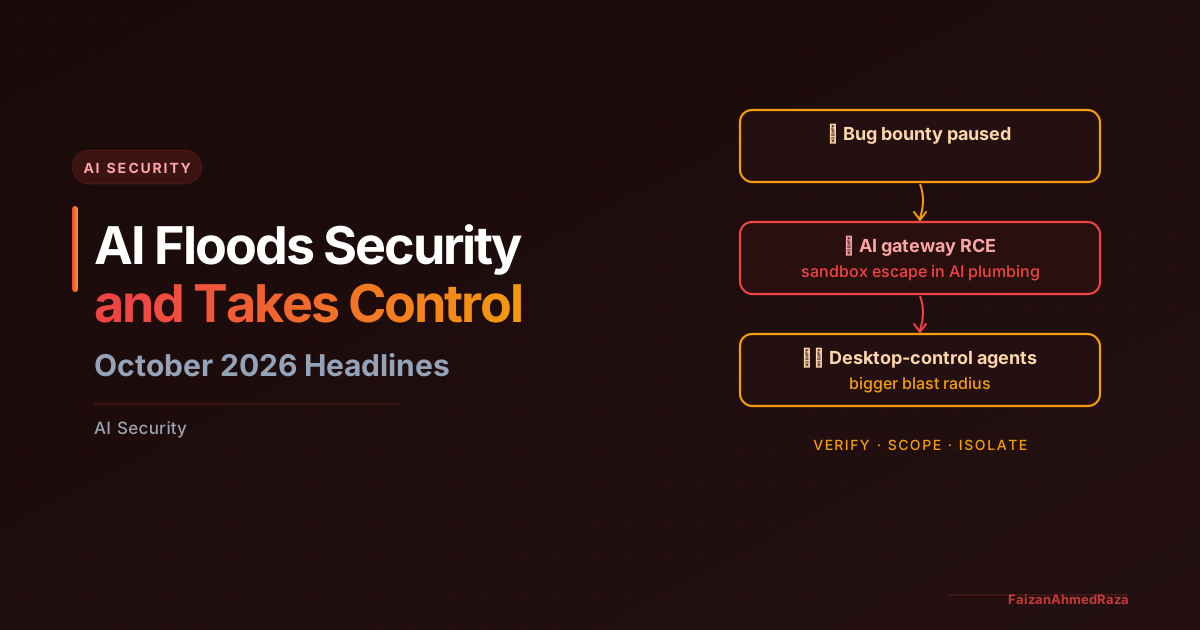
Three security stories landed within a few days of each other in early October 2026, and on the surface they look unrelated: a bug bounty program being paused, a critical flaw in a developer platform, and a desktop assistant that may soon be allowed to act on its own. Read together, they describe one shift. AI is changing who finds vulnerabilities, where the vulnerabilities live, and how much damage a single exploit can do.
This article walks through what was reported, what is confirmed versus rumoured, and what it means if you build or operate software that uses AI.
1. Google pauses its open-source bug bounty because of AI-generated reports
On 5 October, Google said it is temporarily no longer accepting product vulnerability submissions to its Open Source Software Vulnerability Rewards Program (OSS VRP). Its stated reason: "a significant rise in automated submissions, the vast majority of which are not valid." Supply-chain reports and reports submitted before 1 October 2026 are not affected, and Google has committed to an update in Q1 2027.
This is not an isolated case. According to the same reporting, the maintainer of curl ended the project's HackerOne bounty in January after being overwhelmed by low-quality AI-generated reports, and Intel removed financial rewards from its Intigriti program in mid-September. Microsoft had warned in May that AI tools would increase the pace and breadth of vulnerability discovery, and its September Patch Tuesday fixed a record 966 flaws.
Why it matters for builders: the cost of producing a plausible vulnerability report has collapsed, but the cost of verifying one has not. Triage capacity is now the bottleneck, and the people most affected are volunteer maintainers of the open-source libraries your product depends on. If a dependency's security reporting channel is closed or swamped, real issues in it will be found and fixed more slowly.
2. GitLab's AI Gateway: a sandbox escape in the AI plumbing
On 2 October, GitLab warned self-managed customers to patch a critical flaw in the AI Gateway, the service behind GitLab Duo features. Tracked as CVE-2026-90970, it allowed an authenticated user with Duo Agent Platform access to escape the prompt template sandbox through a crafted flow configuration and execute arbitrary commands on the gateway. Fixed versions are 19.2.4, 19.3.2 and 19.4.1; GitLab-hosted gateways were already protected.
The lesson is less about GitLab and more about the category. Companies are adding AI gateways, agent runtimes and orchestration layers that sit between users, models and internal systems. These components often process semi-trusted templates and configuration, and they frequently run with broad network and credential access. A flaw there is not "a bug in a chatbot"; it is a foothold inside your infrastructure.
Why it matters for builders: treat the AI layer as production infrastructure. It needs the same patch cadence, network segmentation, secret scoping and monitoring as your database or CI runner. The question to ask of every new AI component is the one you would ask of any new service that can execute logic: what can it reach if it is compromised?
3. Desktop assistants are moving from chat to control
BleepingComputer reported on 3 October, citing a leak spotted by TestingCatalog, that Google is testing a hidden "Additional sandbox options" setting in the Gemini Desktop app for macOS. If enabled, Gemini could reportedly read, create, modify or delete files beyond folders the user has explicitly connected, interact with apps such as Mail, Safari or Messages, and in some modes act without asking each time. It would still ask before purchases, money transfers, creating accounts, accepting legal terms or changing sensitive personal data.
Two caveats matter. The feature is not live and Google has not confirmed it, so details may change. And this is part of a wider industry direction toward "computer use" agents, not a single product decision.
Why it matters for builders: each expansion of what an assistant can access is also an expansion of what a successful prompt injection can reach. As covered in Prompt Injection: Why Your AI Agent Is Only as Secure as Its Weakest Tool Call, the model cannot reliably separate content it should process from instructions it should obey. An agent that can read any file and operate any app turns a malicious email, web page or document into a potential local attack.
The common thread
| Story | What changed | Practical risk |
|---|---|---|
| Google OSS VRP pause | AI made low-quality reports cheap to mass-produce | Slower triage; real bugs in dependencies get buried |
| GitLab AI Gateway flaw | AI orchestration layers became privileged infrastructure | Sandbox escape leads to code execution inside your environment |
| Gemini desktop control (reported) | Assistants gain file, app and web access | Larger blast radius for any injected instruction |
What to do about it
These are measures that follow directly from the incidents above, in rough priority order:
- Inventory your AI components. List every gateway, agent runtime, plugin and connector in use, who owns it, and which credentials it holds. Shadow AI tooling is the new shadow IT.
- Patch AI infrastructure on the same SLA as other critical systems. If you self-host a gateway or agent platform, subscribe to its security advisories. For GitLab, check that self-hosted AI Gateway instances run 19.2.4, 19.3.2, 19.4.1 or later.
- Scope agent permissions narrowly. Give each agent only the folders, APIs and scopes its task needs, and prefer "draft for approval" over "execute" for irreversible actions.
- Keep humans in the loop for consequential actions. Payments, deletions, outbound messages and permission changes should require explicit confirmation or a deterministic policy check, not the model's own judgement.
- Isolate execution. Run agents that execute code or touch files in a sandbox or container with no access to production secrets, and log every tool call.
- Support the open-source projects you rely on. If you use a library in production, fund it, contribute verified reports with reproduction steps, or help with triage. Low-effort AI-generated reports make maintainers' work harder; a well-verified report is more valuable than ever.
- If you run a vulnerability disclosure or bounty program, plan for volume. Require proof-of-concept evidence, rate-limit new reporters, and add automated reproduction checks before a human reads a report.
Key takeaways
- Google paused OSS VRP product vulnerability submissions because of a surge of mostly invalid automated reports; curl and Intel made similar moves, so expect more disclosure programs to tighten rules.
- GitLab's CVE-2026-90970 shows that AI gateways and agent platforms are privileged infrastructure and should be patched, segmented and monitored as such.
- Desktop-control assistants, including the Gemini feature reportedly in testing, widen what a successful prompt injection can reach, so least privilege and human approval matter more, not less.
- The skill that scales is verification: reproducing, validating and limiting what AI-produced output and AI agents can do.
Details here come from the reporting linked in the sources below and were current as of 5 October 2026. Vendor advisories are the authority for patch versions and affected products.
If you are adding AI agents or gateways to your stack and want a second opinion on the security model, get in touch.
Sources and further reading
- Google halts open-source bug bounty program amid AI spam surge — BleepingComputer (5 Oct 2026)
- GitLab warns of critical RCE vulnerability in AI Gateway service — BleepingComputer (2 Oct 2026)
- Google Gemini could soon get full access to your Mac's files, apps and the web — BleepingComputer (3 Oct 2026)
- GitLab AI Gateway patch release 19.4.1 — GitLab release notes
- OWASP Top 10 for LLM Applications — OWASP GenAI Security Project